
Quality & compliance
Conformity you can re-verify without taking our word for it.
Certificates matter less than the records behind them. Every shipment carries the material traceability, the measured results and the substance declarations that let your own quality team, or an auditor, reconstruct how the part was made.
Certifications, and which factories actually hold them
A group-wide claim is misleading when only some factories are certified. This is the honest breakdown. Certificate numbers, scopes and expiry dates come with the documentation pack, and you are welcome to verify them with the registrar.
| Standard | Scope | Sites | Applies to |
|---|---|---|---|
| ISO 9001:2015 | Quality management system | All | All production |
| IATF 16949:2016 | Automotive quality management | 11 factories | Automotive parts, stampings, castings |
| ISO 14001:2015 | Environmental management | 29 factories | All chemical and coating operations |
| ISO 45001:2018 | Occupational health and safety | 24 factories | Press, foundry and chemical sites |
| ISO 13485:2016 | Medical device quality | 3 factories | Optical and machined medical components |
| AS9100D | Aerospace quality | 2 factories | Machined structural and optical parts |
| ISO/IEC 17025 | Testing laboratory competence | 4 labs | Metrology, spectrometry, photometry |
| ISO 10110 | Optical drawing and tolerancing practice | 5 factories | Optical fabrication and assembly |
| FAMI-QS | Feed additive and premixture safety | 2 factories | Amino acids and fermentation products |
| ISO 22000 / HACCP | Food safety management | 2 factories | Monosodium glutamate, food-grade lines |
| UL component recognition | Insulation systems and materials | 3 factories | Flexible laminates, rigid laminates, varnish |
| Halal and Kosher | Certified production and segregation | 2 factories | Amino acids, monosodium glutamate |
Inspection sequence
Nothing moves to the next gate until the last one signed it off.
Material is not released to a machine until it has been verified against its certificate. Nothing ships until the release file is complete. When a gate rejects, the loop below is mandatory — there is no route that quietly passes a lot through.
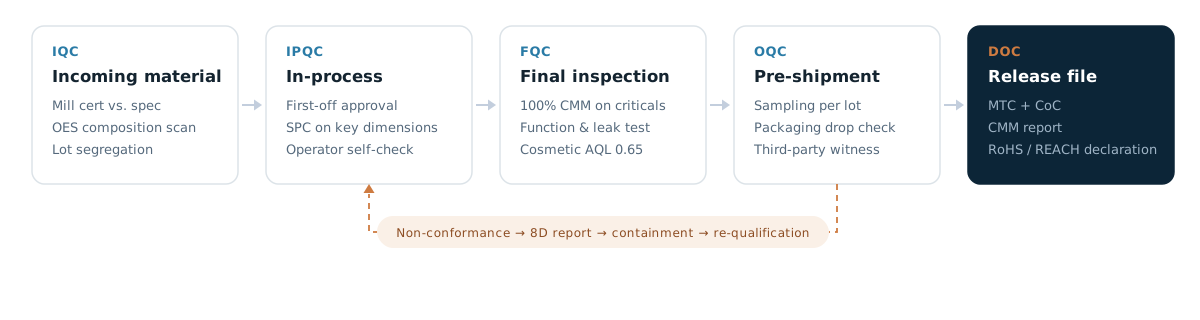
Measurement
Instruments, and what they are trusted to resolve.
Every gauge is calibrated to a national standard on a 12-month cycle, and gauge R&R studies are run per part number before a characteristic is accepted as measurable.
| Instrument | Measures | Resolution |
|---|---|---|
| Zeiss Prismo Navigator CMM | Dimensional and form, temperature-controlled room | MPE 0.9 µm |
| Zygo Fizeau interferometer | Optical surface figure and transmitted wavefront | λ/50 RMS |
| White-light profilometer | Surface roughness and texture | Ra 0.001 µm |
| Optical emission spectrometer | Alloy composition, heat verification | ±0.005% C |
| Handheld XRF | RoHS restricted-substance screening | 2 ppm Pb |
| Industrial CT scanner | Internal porosity, wall thickness, assembly fit | 5 µm voxel |
| Ultrasonic flaw detector | Internal voids in forgings and laminates | Ø0.4 mm FBH |
| Helium mass spectrometer | Seal integrity on closed assemblies | 1×10⁻⁹ mbar·l/s |
| Salt spray and damp heat chambers | Coating durability and environmental life | 1000 h / 85°C 85% RH |
| AC dielectric test set | Breakdown voltage of insulation lots | 0–50 kV |
| Beta thickness gauge | Continuous web thickness on laminating lines | ±1 µm |
| HPLC and polarimeter | Amino acid assay and specific rotation | ±0.2% assay |
| Microbiology laboratory | Plate counts, salmonella and E. coli screening | Per production lot |
Release file
What ships with the goods.
The standard pack below travels with every shipment as a signed PDF set and, where you run a portal, as a direct upload. Additional documents are added by programme. The documentation pack page sets out every form, the standard behind it and how long we keep the underlying data.
Material test certificate
EN 10204 3.1 or 3.2, traceable to the heat or batch, with our own verification result attached.
Certificate of conformity
Signed statement against the drawing revision and purchase order actually shipped.
Dimensional report
CMM results for every characteristic on the ballooned drawing, with measured values, not pass marks.
Capability study
Cpk on designated critical characteristics, updated at each production run.
Substance declarations
RoHS 3, REACH SVHC, POPs, conflict minerals CMRT and PFAS statements where applicable.
Trade documents
Commercial invoice, packing list, certificate of origin and, for EU entries, CBAM data.
When something escapes
Escapes happen in every works. What distinguishes a supplier is the clock they run afterwards. Ours is contractual, not a promise.
- 24 h Containment. Suspect stock identified at your site, in transit and at the plant; replacement or sorting plan issued.
- 3 d Interim 8D. Problem statement, containment evidence and the interim action keeping your line running.
- 20 d Closed 8D. Root cause, permanent corrective action, control plan and FMEA updated, effectiveness verified on a production lot.
- Cost Ours. Sorting, rework, replacement parts and premium freight where the escape originated with us.
Auditing us
Any factory building your parts is open to inspection. We do not keep a showcase factory, and we do not schedule audits for the day after a deep clean.
- Customer audits with ten working days’ notice, including your engineers on the production floor during a live run.
- Third-party agencies you appoint — SGS, TÜV, Bureau Veritas, Intertek — for pre-shipment inspection or system audits.
- Unannounced re-audits once a programme is in serial production, at your discretion.
- Social and environmental audits to SMETA or your own code, covering working hours, wages, and effluent handling.
Regulatory
Trade and substance compliance
Regulation is where cross-border sourcing quietly goes wrong. We treat it as an engineering deliverable with an owner and a date, not as paperwork chased at shipment.
Rules of origin
Substantial transformation assessed per part under USMCA, RCEP, EU FTAs and the relevant national rules, with the evidence file retained for seven years.
Restricted substances
RoHS 3, REACH SVHC, POPs and PFAS screened at incoming inspection by XRF and confirmed by accredited lab testing annually.
Carbon reporting
CBAM embedded-emissions data prepared for EU importers on steel, aluminium and their downstream articles.
Responsible sourcing
Conflict minerals reported on the CMRT template; forced-labour due diligence documented on the tin, tungsten and cotton chains.