Solutions

Problems worth changing a supply chain over.

Tariff exposure, a sole line you cannot walk into, an assembly split across suppliers who blame each other, and a lead time that moves every quarter. Each has a different remedy, and each has a cost we quantify before you commit to it.

“A tariff line moved and our margin went with it.”

We model the delivered cost of the same part built in each producing country, including duty, freight, inventory carrying and the tooling amortisation of a transfer. Where a change of origin is legitimate under the applicable rules we document the substantial transformation and keep the evidence file. Where it is not, we say so — a certificate that fails an audit costs more than the duty it saved.

“One line makes it and we cannot get in the door.”

We qualify a second line in another of our factories while the first keeps running: tooling duplicated or transferred, first article approved, capability proven, then volume split. You end with two approved sources inside one company and a documented switch-over time, usually ten to fourteen weeks for machined parts and one tooling cycle for formed ones.

“Too many suppliers for one assembly.”

We take the whole sub-assembly onto one part number and one drawing tree. Your team stops mediating between a coating house and a machine shop, because both operations are ours and the tolerance stack is ours to close.

“Lead time moves every quarter and we cannot plan.”

Vendor-managed inventory at a bonded warehouse in your region, replenished against a rolling forecast with an agreed safety stock. You call off against stock at your dock date; we carry the ocean transit and the buffer on our own balance sheet.

Execution model

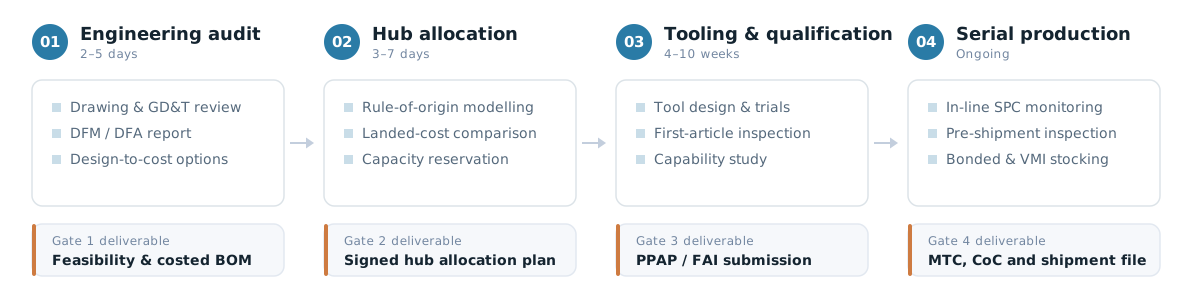
Each phase closes on a document, so nobody has to guess where a programme stands.

Execution model: engineering audit, plant allocation, tooling and qualification, then serial production, each closing with a named deliverable.

How we engage

Pick the depth that matches the programme.

Most buyers start with build to print and stay there. The other two exist for the ends of the range: a catalogue product that needs no drawing, and a programme where the process itself is the confidential part.

Catalogue supply

Our specification, our stock

Standard grades off our running lines — insulation laminate by the roll, amino acids by the pallet, stock optics and graphite blocks. You order against our published specification and we ship against a certificate of analysis.

  • Published specification and datasheet
  • Sample lot before first order
  • Stock held for repeat call-off
Where most programmes start

Build to your print

Your drawing, our line, our conformity

One contract with United Works Group. We choose the plant, own the tooling programme, run production and ship a finished part against your drawing, with liability for dimensional and material conformity sitting with us.

  • Single part number, single invoice
  • PPAP or first-article submission before launch
  • Escape costs, sorting and rework at our expense
  • Second line qualified on request

Dedicated cell

Ring-fenced capacity inside one of our factories

A fenced line with your equipment where you supply it, your process documents and operators trained to your work instructions, run by our supervisors. Suited to programmes where process confidentiality or absolute capacity certainty is the constraint.

  • Physically segregated, access controlled
  • Open-book cost model
  • Exclusive process and staff undertaking

Getting it to your dock

Freight, terms and stock are quoted with the part, not after it.

Packaging design, incoterm and stocking model move the delivered cost more often than the unit price does. We design the pack against the actual lane and drop test it before the first shipment.

ProgrammeWhat it coversTypical use
FCA plantYou nominate the forwarder; we deliver to their gate with export clearance doneBuyers with existing freight contracts
DDP doorOcean or air freight, customs entry, duty and inland delivery to your dockSingle-invoice delivered cost
Bonded stockingFinished goods held duty-suspended in your region, released on call-offVolatile demand, duty deferral
Vendor-managed inventoryAgreed minimum and maximum at your site, replenished on a rolling forecastLine-side supply, kanban pull
ConsignmentStock at your plant, invoiced on consumptionHigh-value, low-turn components
Dual-lane routingSplit shipments across two factories and two ports on the same part numberContinuity-critical programmes

What this looked like in practice

Programmes we ran, told with the figures that mattered.

Customers are unnamed under NDA. The figures are the ones agreed with each customer at programme review, not marketing estimates.

Automotive tier one · North America

Moving heavy chassis stampings out of a tariff line

A tier-one supplier faced a duty step on chassis sub-assemblies imported from East Asia. Our tool room audited the existing die set, found it transferable with a new blank holder, and we shipped it to our Monterrey press shop and ran parallel production for six weeks before switching the volume. Origin content was documented per part number and reviewed by the customer’s own trade counsel before the first entry.

Duty exposure removed
25%
Transfer to first shipment
90 days
Lead time change
−18 days
Certification held
IATF 16949

Industrial sensors · Europe

A sensor head brought onto one part number

A sensor maker bought lenses, barrels, coatings and cleanroom assembly separately, and spent most of its quality effort deciding which supplier owned a defect. We took the whole head into our Penang optical plant, re-cut the tolerance budget so two surfaces could be loosened without touching optical performance, and now ship the assembly tested and sealed.

Suppliers in the chain
4 → 1
Assembly scrap rate
< 0.2%
Unit cost change
−11%
Inspection
100% interferogram

Traction motor builder · Europe

Slot liners delivered formed instead of flat

A motor builder was buying DMD laminate in rolls and converting it in-house, losing close to a fifth of the material as scrap and holding a die set it did not want. We moved to die-cut and cuffed liners made to the lamination drawing on our own rotary line, tested for breakdown voltage per lot, and delivered in insertion-ready trays.

Converting scrap
18% → 3%
Thermal class
F 155 °C
Breakdown voltage
≥ 12 kV/mm
Insertion faults
None since changeover

Bring us the part that keeps you awake.

The single-sourced one, the one with the tariff exposure, or the assembly nobody will own. We will tell you what we would do with it and what it would cost — including when the answer is to leave it where it is.